From ERP record to signed eCoC: connecting eCoC EU² to stage 1 and stage 2 vehicle production
The eCoC data is already there. The hand-off is the hard part.
By the moment a vehicle leaves the line, every value an eCoC asks for has already been produced and approved somewhere within your systems:
- Type approval references plus variant and version codes live in your homologation master data.
- VIN, fitted options, masses, axle loads and dimensions are emitted by the production order or the configurator.
- Engine, gearbox, emissions class and fuel type are tied to the variant.
- Conformity of Production (CoP) records are recorded by your quality system.
The issue was never that the data is missing. It is that today the data is scattered across the ERP, the MES and the homologation database — and is extracted manually to populate an IVI XML template, then checked manually, signed manually and pushed manually to the national access point. That holds up for a handful of vehicles. It collapses at hundreds or thousands a year.
How the eCoC EU² software connects
eCoC EU² is designed to ingest the data you already hold. We rely on three integration patterns, chosen according to how mature your IT landscape is:
1. Direct API integration
On modern ERP and MES platforms, the production system sends the vehicle record to the eCoC EU² software via a REST or message-bus API the instant quality signs off the build. A mapper tailored to each customer translates the payload into the IVI 2.0 schema.
2. File drop (CSV / XML / EDI)
When the ERP is locked down or change windows drag, eCoC EU² collects a scheduled export from a monitored folder, an SFTP location or an S3 bucket. The mapper and the output stay identical. Plenty of customers begin here and move up to API integration once they have seen the payoff.
3. Configurator-driven mode
Where a vehicle configurator already captures how options shift masses, dimensions and emissions, eCoC EU² can consume its output as-is. This is the tidiest approach for stage 2 builds, in which every body variant alters payload and approval references.
A typical inbound payload: production order ID, VIN, base type approval, variant and version, fitted options, measured masses and completed-vehicle CoP flags.
The ERP and MES systems eCoC EU² supports
We have delivered or scoped integrations against the systems that vehicle body builders and stage 1 / stage 2 manufacturers across the EU genuinely operate:
| Layer | Systems we support |
|---|---|
| Tier-1 / OEM ERP | SAP S/4HANA, Oracle Fusion Cloud ERP |
| Mid-market automotive ERP | Infor CloudSuite Automotive, Plex (Rockwell), DELMIAworks (Dassault Systèmes), Microsoft Dynamics 365 F&O, IFS Cloud, Epicor Kinetic |
| DACH / EU body-builder ERP | abas ERP, proAlpha, Sage X3, SAP Business One |
| Production execution / MES | Siemens Opcenter, Rockwell Plex MES, Dassault Apriso, AVEVA System Platform, Tulip |
| PLM / type approval data | Siemens Teamcenter, Dassault ENOVIA, Aras Innovator, in-house homologation databases |
If your system isn't listed, the approach does not change — we write a mapper against your data contract. The tricky part is your business rules, never the connector itself.
The full end-to-end data flow
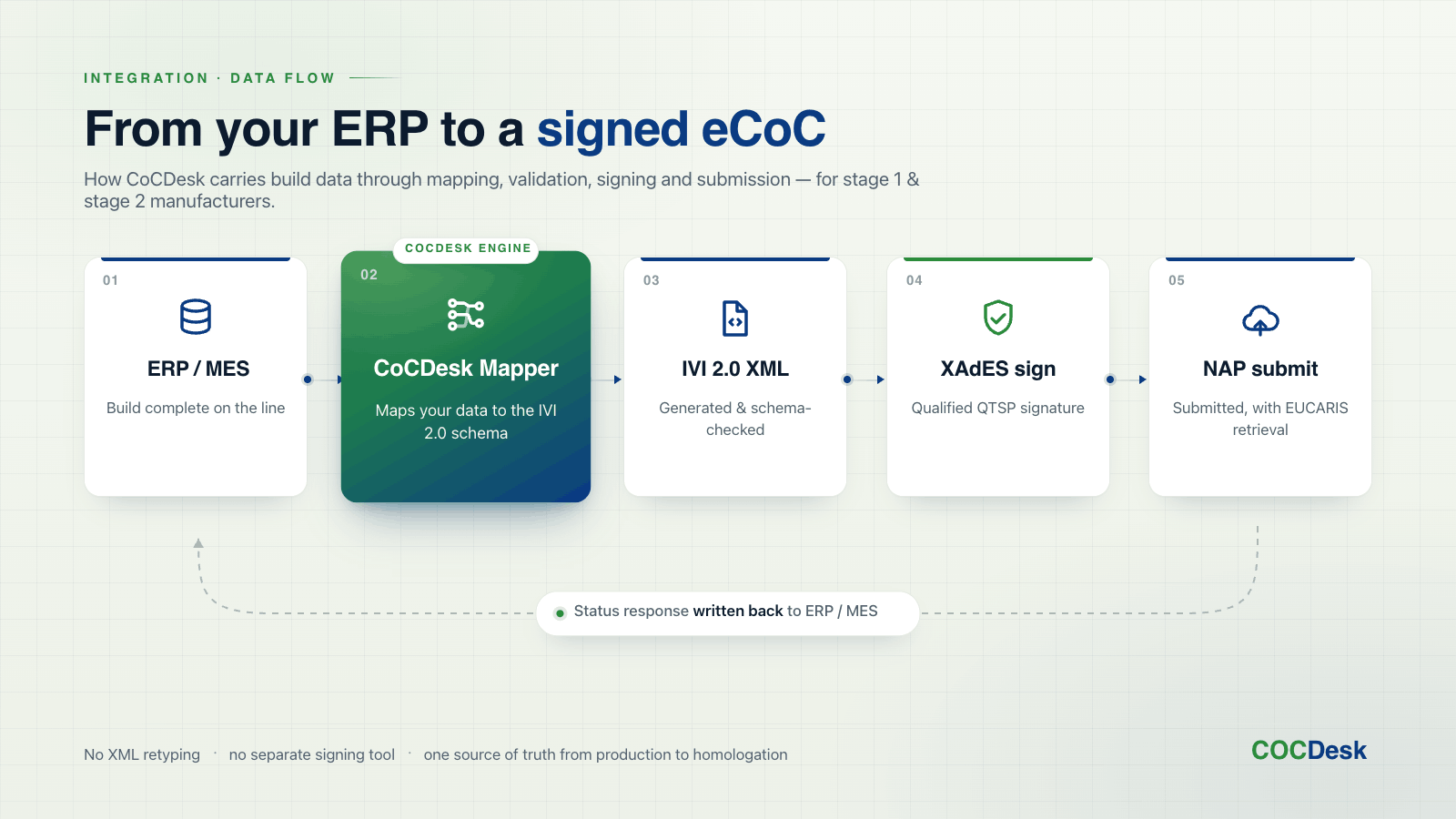
The diagram above traces the complete route. Starting from the production system, eCoC EU² executes the customer-specific mapper, generates schema-validated IVI 2.0 XML, attaches a XAdES signature issued by a Qualified Trust Service Provider on the EU Trusted List, and lodges it with the target national access point (NAP) — drawing on EUCARIS retrieval wherever the destination Member State allows submission through a foreign NAP.
The receipt, along with any reasons for rejection, is written straight back onto the originating record in your ERP or MES — so the eCoC status appears beside the vehicle in the production system rather than in some separate spreadsheet.
Stage 1 versus stage 2: the multi-stage hand-off
What the integration looks like depends on whether you build the base vehicle or finish it off.
Stage 1 — base-vehicle manufacturer
Usually chassis and chassis-cabs. Here the eCoC EU² integration hangs off the production-order completion event. The eCoC you lodge describes the incomplete vehicle and carries forward the base type approval reference that the following stage will rely on.
Stage 2 — body builder / converter
Your eCoC must point back to the upstream eCoC that stage 1 issued. eCoC EU² manages this either by pulling the base eCoC XML through EUCARIS retrieval (the preferred path) or by taking the base type approval reference from the chassis manufacturer's data sheet. Your stage 2 eCoC then layers on completed-vehicle masses, body type and axle configuration before re-signing.
The hand-off pain point we remove
Mass and dimension figures drift between what stage 1 declared and what stage 2 actually measures. eCoC EU² surfaces that gap and requests sign-off before the eCoC goes out — so you avoid a NAP rejection caused by completed mass exceeding the technically permissible mass.
What an integration project involves
For a typical vehicle body builder running Sage X3 or proAlpha:
- Week 1 — data-mapping workshop. We sit down with your homologation lead and ERP administrator and trace the IVI 2.0 schema against your own fields. The deliverable is a single-page data contract.
- Weeks 2–4 — the connector is built and aimed at your test environment. We produce test eCoCs from sample vehicles and lodge them with the NAP test endpoint.
- Weeks 5–6 — a parallel run. eCoC EU² issues eCoCs side by side with your current process, and the output is checked field by field.
- Week 7 onwards — the production cutover. Manual eCoC generation is retired.
With stage 1 manufacturers on SAP S/4HANA, discovery and the security review run longer, yet the technical build moves faster because the source data is cleaner.
When the integration earns its keep
Realistically, the upper limit for manual eCoC generation is fewer than 50 eCoCs per year. IVI 2.0 XML was never meant for human eyes — it is dense, heavily nested and packed with code-list values that look interchangeable but are not. Typing it out by hand at any real volume will produce errors, and each error means a NAP rejection followed by another re-sign cycle. Past that point, ERP/MES integration stops being a cost saving and becomes the only workflow that survives contact with reality.
One thing teams tend to underrate: the integration is not purely about producing eCoCs more quickly. Since a single source of truth feeds both production and homologation, you also wipe out a whole category of mismatches between your build records and the documents you file with the authority — precisely where Conformity of Production audits tend to turn awkward.
eCoC EU² for stage 1 and stage 2 manufacturers
- IVI 2.0 XML produced straight from your ERP, MES or configurator
- Customer-specific mappers, kept current as schemas evolve
- Schema checks ahead of submission, with signed XAdES output from a QTSP certificate
- Direct filing to every EU NAP, plus EUCARIS retrieval to pair base and completed vehicles across borders
- Status written back to the originating ERP or MES record
- A complete audit trail for Conformity of Production
If you build vehicles in stages, the real bottleneck for the 5 July 2026 deadline is not the regulation — it is the hand-off between your production system and the registration authority. That hand-off is something we can stand up in a matter of weeks.
Next article
eCoC across the EU: where things stand
Ready for the EU eCoC rollout?
Book a free demo and see how eCoC EU² can have your eCoC process production-ready across every EU Member State.